




In cricket, few positions carry the aura of the No. 3 batter. It’s where the elegant stroke-makers and dependable anchors like Virat Kohli, Kane Williamson, and Ricky Ponting usually live. The role is almost sacred. For casual bettors and fantasy players, it often feels like the safest choice for top run scorer. But that perception is flawed.
The No. 3 Illusion: Safe, But Statistically Shaky
When it comes to T20s and ODIs in particular, betting on the No. 3 is often the worst value on the board. The odds rarely match the real opportunities, and in the fast-paced nature of modern cricket, time in the middle is everything. This article breaks down the numbers and logic behind why No. 3 is a betting trap and where the real edge lies.
On paper, No. 3 looks ideal. They avoid the new ball but still have time to bat. They’re often the most technically sound batter in the lineup, and usually a captain or vice-captain in fantasy formats. But here’s the trap: they don’t always get to bat, and when they do, they’re frequently under pressure.

The Hidden Risks Behind the Most Misunderstood Position in T20 Cricket
When casual bettors scan the lineup for a T20 match, the No. 3 batter often stands out. It feels like a safe play as a top-order slot and a big name with a high average. But this is exactly where the trap lies. Here’s why:
1. No Guarantee of Time at the Crease
In matches where the openers dominate, the No. 3 may not be required at all, or they may walk in with just a few deliveries left. It’s not uncommon to see them face fewer than 10 balls. Betting on a batter who may not even get a bat is a dangerous proposition.
2. Thrown Into Chaos When Early Wickets Fall
Conversely, when early wickets tumble, the No. 3 is often thrust into high-pressure scenarios either during a powerplay blitz or a total collapse. They’re forced to either accelerate too early or rebuild from the rubble. Both scenarios skew performance expectations drastically.
3. Name Value ≠ Role Clarity
This is perhaps the most consistent market inefficiency. Top teams frequently place their biggest names at No. 3 not because it’s the best tactical use, but because of convention or balance. Bookmakers often inflate odds based on reputation, not situation. That leads to overpriced picks who don’t justify the risk.
The First Six Overs Are a Volatility Minefield. The T20 powerplay is a zone of extremes. Bowlers attacking, fielders up, pressure sky-high. It’s rare for the No. 3 to enter at the perfect moment. They’re either starved of opportunity or exposed at the worst possible time.
Bottom Line: The No. 3 batter looks like a premium investment but in T20s especially, they’re often a statistical dead zone. If you’re targeting consistent returns, you’re better off backing the openers or waiting until the middle order, where role clarity and game context drive value.
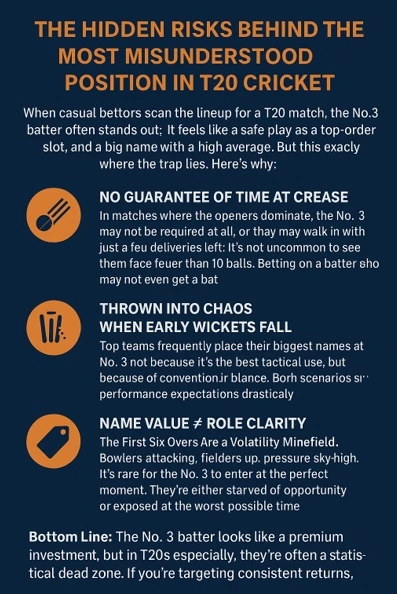
The Power of Openers: Why They’re Usually the Best Bet
In both T20 and ODI formats, the math is straightforward: the earlier a batter walks in, the more deliveries they can face. And in cricket, opportunity is everything. That’s why openers remain the most reliable and profitable targets for top run scorer bets. Keep it as simple as this: More balls, more runs, more value. There are three key factors as to why openers deliver more than just big starts.
1. They Maximize Their Time at the Crease
Openers have a head start on everyone. They begin the innings and, theoretically, can bat through all 20 or 50 overs. Even if they don’t, the sheer volume of balls faced gives them a statistical edge no other position can match.
2. They Exploit the Powerplay
The early overs come with fielding restrictions like fewer boundary riders and more scoring options. This window is tailor-made for aggressive openers who can clear the infield and rack up runs quickly. The reward-to-risk ratio here is often in their favor.
3. Their Roles Are Consistent and Predictable
Openers know when they’re going in and who they’ll face. That stability matters. Unlike floaters or flexible middle-order batters, openers rarely get shuffled around. The consistency of their role makes them far easier to analyze and far safer to back.
Markets often price players based on reputation, not function. And undervalued aggressors outperform the odds. So when a lower-profile opener with a strike-first mindset gets overlooked, sharp bettors find value. These hitters may not have the average of a No. 3, but they do have the right tools to top the chart on any given day. And the data backs it up.
Take the recent IPL season as an example: nearly 60% of top run scorer bets were won by openers, even though many had lower averages and strike rate consistency compared to their No. 3 counterparts. That’s not a fluke.
Bottom Line: In limited-overs cricket, openers have the clearest path to stacking runs. They benefit from role clarity, favorable conditions, and volume of deliveries. That is a trifecta that makes them the smartest and safest betting option more often than not.
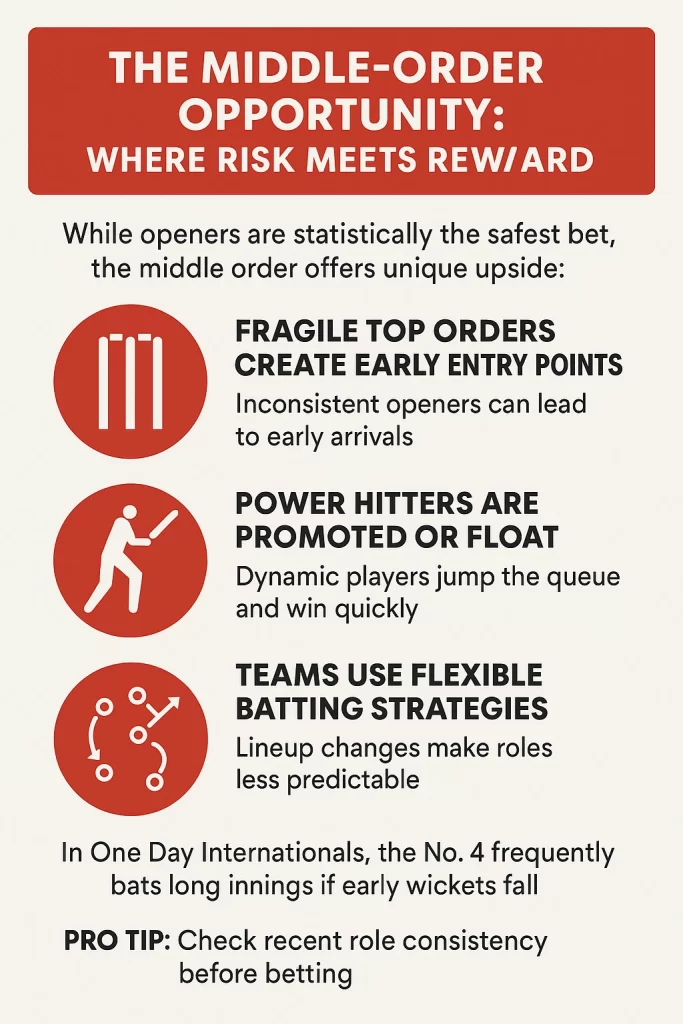
The Middle-Order Opportunity: Where Risk Meets Reward
While openers are statistically the safest bet for top run scorer markets, the middle order holds a different kind of value that savvy bettors are quick to exploit. With the right conditions, Nos. 4 and 5 can present a high-upside, low-competition edge. Here are three key opportunities that make the middle order the smart play.
1. Fragile Top Orders Create Early Entry Points
On teams with unreliable or out-of-form openers, middle-order batters often enter much earlier than expected. This transforms a typically short opportunity window into a full innings and suddenly, that No. 4 looks like a No. 2.
2. Power Hitters Are Promoted or Float
Players like Nicholas Pooran, Glenn Phillips, or Heinrich Klaasen can bat anywhere from No. 4 to No. 6. And when promoted, their strike power makes them immediate threats. These players can flip a game in 20 balls, and when given the time, they win top run scorer bets more often than the odds suggest.
3. Teams Use Flexible Batting Strategies
Some sides embrace floating roles or use pinch-hitters at No. 4/5, creating surprise value. Others consistently deploy anchors (players who are sent in regardless of the match situation) creating a predictable opportunity for bettors watching trends.
In One Day Internationals, the No. 4 batter can become the innings engine if early wickets fall. They often have the chance to bat 30–40 overs, a dream setup in matches where openers collapse or slow down. Despite that, markets rarely price them as favorites.
Pro Tip: Before placing a middle-order bet, check recent innings progression, batting orders, and role assignments. A team is consistently using a specific player at No. 4 regardless of situation, that’s hidden value in plain sight.
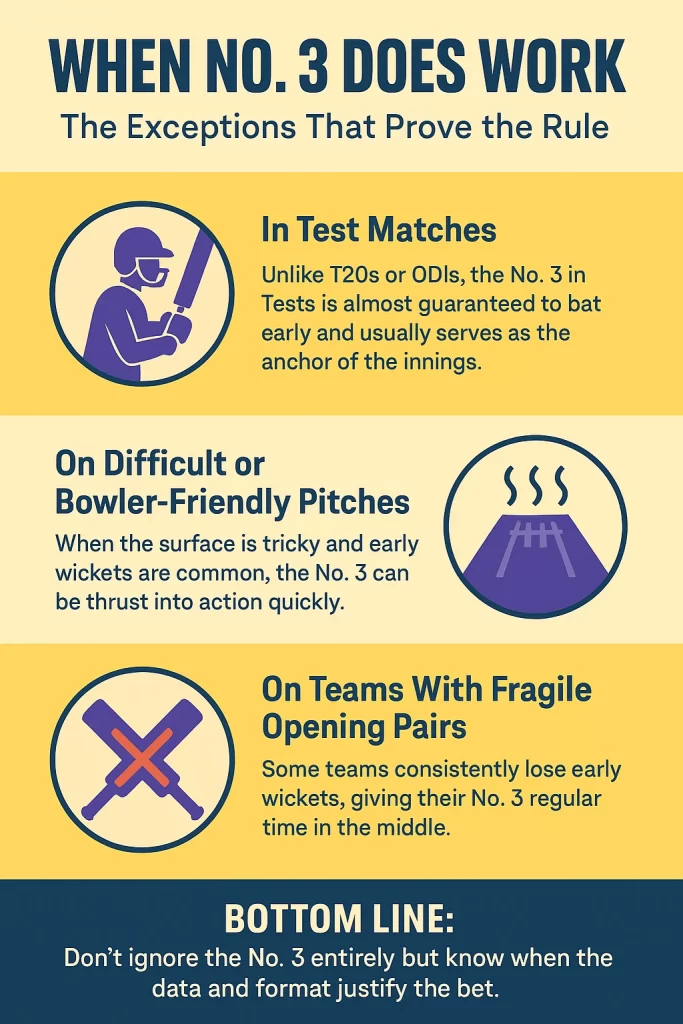
When No. 3 Does Work : The Exceptions That Prove the Rule
While betting against the No. 3 batter is usually a sound strategy in limited-overs cricket, it’s important to recognize that not all No. 3s are traps. There are specific match conditions and formats where the No. 3 becomes a strong , and sometimes even ideal, play. Betting on the No. 3 makes sense in scenarios like these:
1. In Test Matches
Unlike T20s or ODIs, the No. 3 in Tests is almost guaranteed to bat early and usually serves as the anchor of the innings. They are expected to face a large volume of deliveries and carry the innings deep. Betting on No. 3 in Tests is often optimal.
2. On Difficult or Bowler-Friendly Pitches
When the surface is tricky and early wickets are common, the No. 3 can be thrust into action quickly. Anchors or technically sound batters in that slot tend to outperform in these low-scoring environments, where survival and strike rotation matter more than power.
3. On Teams With Fragile Opening Pairs
Some teams consistently lose early wickets, giving their No. 3 regular time in the middle. In these setups, No. 3 can function more like a second opener, and that changes the entire value proposition.
But these scenarios are rare and are oftenthe exception, not the rule. In T20s and ODIs, especially in fantasy contests and betting markets, the No. 3 is often over-loved and over-valued. Odds are inflated due to big names and averages and not opportunity or game context.
Bottom Line: Don’t ignore the No. 3 entirely but know when the data and format justify the bet. Outside of red-ball cricket or obvious top-order weaknesses, you’re usually better off looking elsewhere.
What the Markets Get Wrong
One of the most common mistakes in top run scorer markets, and even in fantasy cricket, is confusing name recognition with real value. Reputation is priced in but opportunity wins bets. Markets tend to overvalue batters at No. 3 simply because they’re often the team’s marquee name. But in limited-overs formats, opportunity trumps reputation every time.
Big names don’t always get big chances. The No. 3 spot is frequently filled by star players, top-order anchors, national captains, or high-AVG performers. But that doesn’t mean they’re a smart bet. If those stars only face 10 balls, or walk in during low-leverage moments, the odds are stacked against them no matter how skilled they are.
This is where most betting models (and many fantasy players) go wrong. They chase status over scenario.
Before backing a top run scorer, ask yourself:
How often does this batter face 30+ balls?
Volume is everything. If they aren’t getting time in the middle, they aren’t scoring big.
What’s the average entry point for the No. 3 on this team?
If the openers are consistently batting deep, No. 3 may enter too late to matter.
Are the openers high-risk or in form?
A volatile opening pair increases the value of No. 3. Solid openers? Less so.
Has the batting order changed recently?
Floating roles and team experiments can shift value overnight. Stay updated.
Does this format or pitch favor quick starts or deep anchors?
A slow wicket rewards technique and patience. A flat track during a powerplay? That’s openers’ territory.
Don’t pay for brand value. If the No. 3 isn’t entering consistently early, or rarely tops the scorecard, you’re not betting on performance. In those scenarios, you’re paying a premium for brand recognition. And in sharp betting, that’s where value goes to die.
Bottom Line: The best bets aren’t always the biggest names. They’re the ones getting the most opportunity in the best conditions. Watch the trends, read the context, and bet the role, not the hype.
Conclusion: Go Where the Balls Are
In modern limited-overs cricket, opportunity is the currency that matters most. And in formats where innings can turn in 20 balls or less, volume of deliveries faced is the clearest indicator of upside. That’s where the No. 3 batter so often falls short.
Despite their reputation as the most technically sound or reliable player, they’re frequently at the mercy of match conditions. Sometimes they walk in with 12 overs left and a mountain to climb. Other times, they never bat at all. The role often looks stable on paper, but in practice, sometimes it’s anything but consistent.
If you’re serious about identifying value, whether in betting markets or fantasy contests, you need to look beyond reputation and toward role clarity. That means targeting:
Openers: They start the innings and are best positioned to face the highest number of deliveries.
Middle-Order Enforcers: They come in with license to attack against fatigued bowlers and defensive fields.
Consistent Contributors: Players that are usually undervalued by the public but regularly involved in meaningful phases of play.
These players may not always carry the biggest name or highest career average, but they’re embedded in roles that maximize opportunity. In short-form cricket, that’s what wins bets, contests, and matches. And if you’re serious about finding the edge, fade the reputation picks and follow the opportunity. So, the next time someone says, “No. 3 is the safe pick,” ask: “Safe for who?”

Want More Betting Strategy Like This?
If you found this breakdown of the No. 3 batter insightful, don’t miss our guide on another common mistake: betting the powerplay. It’s a high-risk phase that often looks safer than it is then read Why Betting the Powerplay Is a Trap.

Want to Dive Deeper into the World of Cricket Betting?
If you’re serious about turning insight into edge, Cricket Betting Tips by Wes Wynn is your next must-read. Packed with strategies from someone who’s been in the trenches, this book breaks down how to think like a bookmaker—and beat them at their own game. Buying through our affiliate link at Bookshop.org supports indie bookstores and 365NotOut’s mission to bring smarter cricket content to fans like you. Grab your copy HERE.